Build Your Family’s Bedtime Routine
Three moves, one evening drawn to scale.
Three moves and you leave with a card for the refrigerator door: anchor the clock, choose the steps, and lay out the evening. A real family’s routine is already on the board; cut, add, and rename until it is yours. Once the card is in hand, three more moves can make the routine stronger.
01Anchor the Clock
When should your child be asleep?
Start from the morning, not the evening. Enter your learner’s age and the time they need to be up, and the recommended sleep range works backward to an asleep-by window. Everything else in this session hangs on these two answers.
Fine-tune: naps, time to fall asleep, target sleep
02Choose the Steps
What does your family’s evening already include?
Tap any step to add it to the timeline; tap it again to take it off. Every column ends with an Add Your Own card.
Drag to reorder and change any duration. Each card carries a note on how to use it; the steps you create go straight onto the timeline and stay in your library. Older kids and teens get the Help Your Future Self step at the bottom of this move. Switch to Clinician view to see the survey counts behind each step.
One step for older kids and teens: a few quiet minutes spent making tomorrow easier. Pick what helping your future self means in your house; the picks travel as one step on the timeline and print on your routine card.
03Lay Out the Evening
Your evening, to scale
Everything before the bedroom on the top row, everything once you are in for the night on the bottom. The timeline ends at lights out, so the start time moves as the routine grows.
bedroom →
out
Your Card
Save it, print it, or send it
The words that run a step: praise after it, a game during it, a choice before it, help on the hard one. Each line prints on the card under How We Run Each Step, so every caregiver runs the steps the same way.
Make It Stronger
Your routine works as it is. These add closeness, pull, and play.
Open any of them when you are ready; whatever you use here prints on the card. Connection marks the minutes you spend together. Worth Wanting gives the routine something to point toward. Weave It Through breaks a block of demands up with play. Setup Choices are the house rules that help the routine run.
The Nine Moves
Add fun, take away unpleasantness
The nine moves from the talk, by name. Switch one on and the Builder does what it already does for it: the weave turns on, the favorite joins the bedroom menu, the schedule ticks its setup box, the 7:25 announcement joins the timeline, and the rest become lines under How We Run Each Step on the card.
The terms and sources are the cliff tool’s own, read 2026-10-10; the Builder’s step and routine sources stay under Where the Numbers Come From.
04Build In Connection
More touchpoints of connection, built into the routine you just made
Steps marked with a heart count as time together; pick what fits your child’s age.
The end of the day is the natural window for physical closeness and unhurried talk. The meter in Move 3 keeps score of the connection minutes. These ideas are drawn from the survey steps families reported and from our clinical practice.
05Make Bedtime Worth Wanting
Give the routine something to point toward
Bedtime becomes worth wanting when things your child genuinely loves exist only there. This move is the menu: pick the loved things that live only in the bedroom. They are not earned by finishing the steps and they are not taken away; they happen every night, in the bedroom and nowhere else, so the bedroom is where the evening is headed. The practical tactics (screens, lights, the bedtime pass) live in Setup Choices; they help the routine run, but they are not the reward.
This is where the routine gets its pull. Pick the things your child genuinely loves that will now live only in the bedroom. They are not earned by finishing the steps; they happen every night, in the bedroom and nowhere else. Two pools, from the traffic-light idea: while the yellow light is on, the routine is still going and you are part of the fun; when the light turns red, it is sleep time, and only the quiet comforts stay.
Yellow Light · in bed, routine still going · you are part of it
In bed, routine still going. You are part of it.
Red Light · after lights out · quiet comforts only, no social
After lights out. Quiet comforts only, no social.
06Weave It Through
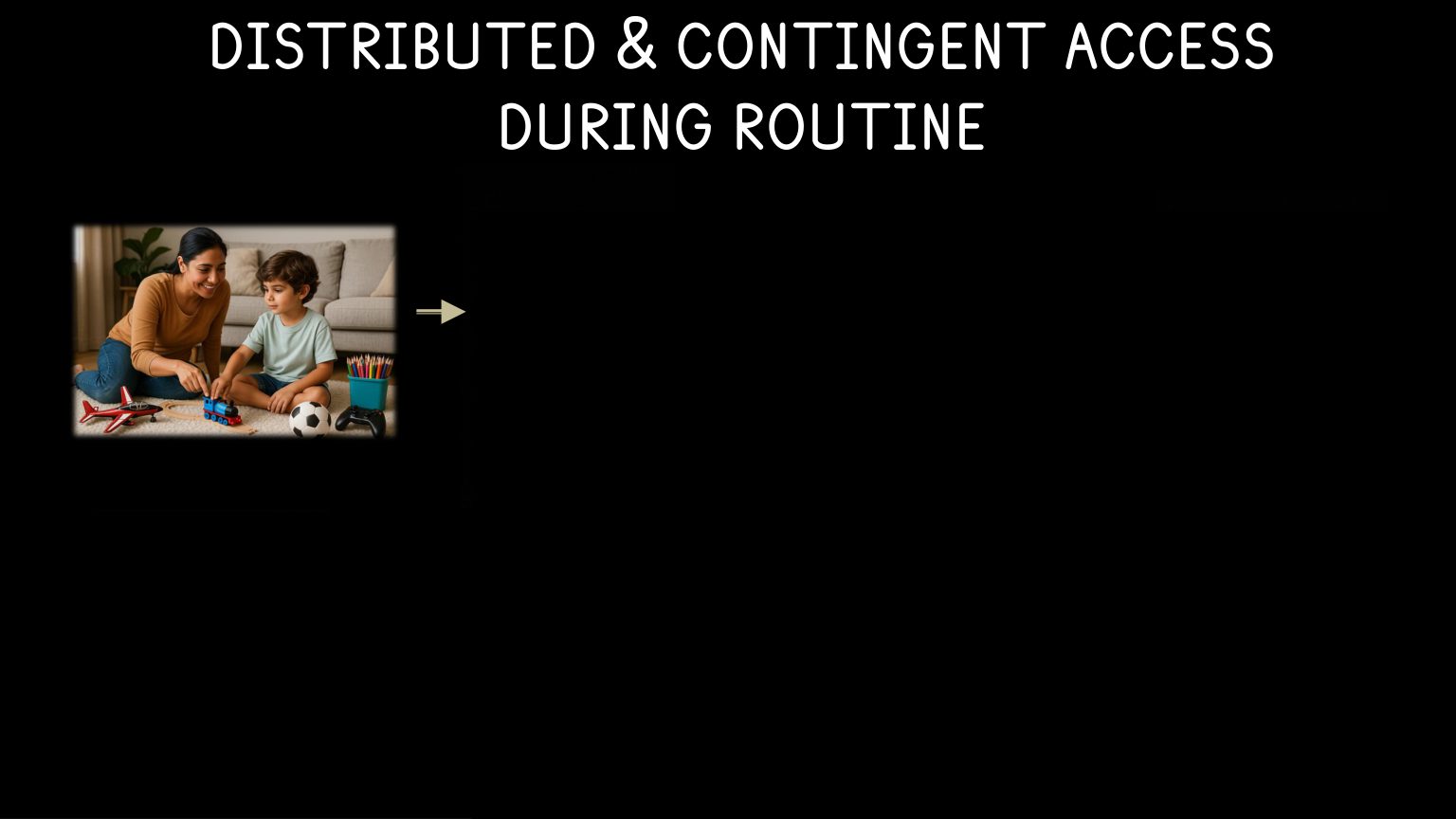
Distribute the routine inside one favorite activity
Turn this on and the timeline redraws with play woven between the steps before the bedroom. The total still lands on lights out.
Instead of a block of demands before bed, the evening can breathe: play the family game, pause for pajamas, play, pause for teeth, play, then the last quiet steps and bed. Once you are in for the night, the wind-down runs unbroken unless you tick the box to weave inside the bedroom too. This pattern is conceptually indicated by the behavioral model; it has not yet been evaluated in sleep studies.
Show the nine slides from the talkHide the slides
Setup Choices
Tactics that help the routine run; they are not the reward
A card with a gold button places a block of time on the timeline; a checkbox is a house rule that takes no minutes and prints on your card under Our Setup.
These are treatment tools rather than reasons to want bedtime, which is why they live here instead of Move 5.
The Family Evening
Build A Bedtime Routine, Live
Pick a family, and we build its bedtime routine together.
Where the numbers come from
The asleep-by window uses the American Academy of Sleep Medicine consensus recommendations (Paruthi et al., 2016, Journal of Clinical Sleep Medicine, 12(6), pp. 785–786): ages 1–2, 11–14 hours per 24 hours including naps; ages 3–5, 10–13 hours including naps; ages 6–12, 9–12 hours; ages 13–18, 8–10 hours; all verified against the source (PDF 2026-07-14; full text via PMC4877308, 2026-07-28). Ages 19–21 use the National Sleep Foundation adult guidance of 7–9 hours per night (thensf.org, verified 2026-07-28), concordant with the AASM adult consensus of 7 or more hours for ages 18–60 (Watson et al., 2015, SLEEP; PMC4434546). The 30–40 minute ceiling is a published practice point in Mindell & Williamson (2018, Sleep Medicine Reviews; verified against the full text, PMC6587181, 2026-07-28); the routine-frequency dose-response is Mindell et al. (2015, Sleep, 38(5), pp. 717–722; verified against the full text 2026-07-29 and re-verified against Table 2 on 2026-08-05): across 10,085 mothers’ reports from 13 countries and regions covering children the paper describes as ages 0 through 5.11 years, more nights per week with a regular bedtime routine was associated with earlier bedtimes, shorter sleep-onset latency, fewer night wakings, and more nighttime sleep, an association only, not a demonstration of cause; the authors write that “causal interpretation cannot be made from our correlational findings.” Two things that study could not tell us: routine frequency came from one survey question, and mothers were never asked what their routine contained, so nothing in it speaks to which steps help. Total sleep across 24 hours was the one outcome that did not follow the gradient. The study was sponsored by Johnson & Johnson Consumer & Personal Products Worldwide, one co-author was a Johnson & Johnson employee, and the senior author has consulted for them; the reference bars are the Reed & Luczynski 2026 survey median (30-minute routine, n = 91), the Prokasky et al. 2019 diary mean (43.2 minutes, n = 185), and the survey’s median full evening of 75 minutes from routine start to a sleeping child; the 18.6-minute figure and the 4.16 activities-per-night mean are also Prokasky et al. 2019 (Early Childhood Research Quarterly, 49, pp. 18–27, Table 2; verified 2026-08-05). That study followed 185 typically developing toddlers, all aged 30 months, in one midwestern United States city, predominantly White and college-educated. Its routine measures are entirely parent-reported from a two-week sleep diary: routine length runs from the reported routine start to the child being in bed, and the 18.6 minutes is how far a typical night’s routine length fell above or below that same child’s own average length, not a change in which steps happened. The honest headline from that paper: the routine measures tracked parent-reported sleep but, in the authors’ own words, “None of the bedtime routine variables were related to the actigraph-recorded measures of sleep,” and those same parents reported 10.53 hours of sleep where actigraphy recorded 8.36; the step list and its family counts are the survey step data (n = 100); these values were verified 2026-07-12 with receipts in the master schematic. Steps tagged H&J 2010 are items that loaded on either the adaptive-activities or the maladaptive-activities component in Henderson & Jordan (2010, Journal of Psychopathology and Behavioral Assessment, 32(2), pp. 271–280, Table 1; n = 226 US caregivers of children ages 2–8, southeastern United States), read against the source text on 2026-07-14 and re-verified against Table 1 on 2026-08-05. Those two components come from a principal components analysis with Promax rotation, and the labels adaptive and maladaptive were the authors’ own categories written before the analysis, which then confirmed the split; the analysis did not discover them. Staples et al. (2015, Monographs of the Society for Research in Child Development, 80(1), pp. 141–159) percentages are the 36-month wave (n = 77) of a three-wave longitudinal diary study, verified against Table 1 on 2026-08-05; each family’s checklist was built from that mother’s own description of her routine, so the percentages are not comparable to fixed-checklist studies, and that paper linked no individual activity to any sleep outcome. The single Brown figure is Brown, Rhee, & Gahagan (2016, Clinical Pediatrics, 55(6), pp. 525–531, Figure 1; verified 2026-08-05): a convenience sample of 62 Latino parents of four-year-olds recruited from one community pediatric clinic waiting room in northern San Diego County, reporting how often each activity happened in the hour before bed over the past month; the percentage is the share answering “often” or “always” on a five-point scale, not the share of families who ever do it. That study used the same Bedtime Routines Questionnaire that Henderson & Jordan built, which is why the two sources name the same activities; steps tagged “idea” are prompts from our clinical practice and Sleepy Star and carry no data claim. The bedtime pass is Friman et al. (1999, Archives of Pediatrics & Adolescent Medicine); pre-bedtime access to preferred items is a package element in Jin, Hanley, & Beaulieu (2013); the Three Moves framing follows Luczynski & Rodriguez (2015) and Handbook Ch. 17. Step durations are starting guesses for you to change; the research speaks to the whole routine, not to any single step. Connection ideas and items marked “our clinical practice” are clinical suggestions, not published findings. Your child’s settle time is your estimate, not a measurement. The Yellow Light and Red Light bedroom menus follow the signaled-availability framework from the BLN pediatric sleep curriculum (Luczynski, 2026).